

 Jane Verdonk
The Sicilian city of Syracuse was founded in 734 BC. founded by Greek settlers from Corinth. Slowly it grew into the most important city on the island and became a rival to Athens and Carthage. The city became wealthy with the export of grain. At that time, Syracuse was considered one of the most beautiful cities in the world.

Table of contents
A piece of Syracuse history
The wealth came to an end when the Romans in 212 BC. destroyed the city. The famous Archimedes (founder of the principles of (hydro)statics, the lever principle and the exclamation 'eureka') also died in this war.
According to the stories, he tried to protect the city by designing war machines like huge catapults, but in vain. Works of art from the city were transported to Rome, this was the first major art robbery.

After the Romans, the city subsequently fell into the hands of the Arabs, Byzantines, Normans and the French (house of Bourbon).
In 1693, a severe earthquake struck southeastern Sicily, including Syracuse, and many buildings were destroyed. Bombings in World War II also caused heavy damage a few centuries later. After the war, Syracuse grew rapidly with the arrival of many workers who moved from the countryside to the city.
Since the 90s, restoration of the old center has started and since 2005 Syracuse has been on the UNESCO World Heritage List.
The old center of Ortygia (Ortigia)


The old center is Ortygia. Originally this was an island, only in 1870 was a bridge connecting Ortygia to the mainland. The Latin name for Ortygia was Cortunix that quail means.
According to legend, Zeus fell in love with Asteria, but the love was not reciprocated, so Zeus turned her into a quail, whereupon she plunged into the sea and became an island. Poseidon (the god of the sea) secured the island with 4 pillars in the bottom of the sea.

Ortygia was also destroyed by the earthquake of 1693 and it was rebuilt in baroque style afterwards. With some adjustments, the original Greek city plan has been maintained. There are 2 main axes, running from north to south – Via Dione and Via Roma – and 2 that run from east to west – Via della Amalfitania and Via della Maestranza.
Ortygia consists of 4 districts, each with its own character:
- Northeast (Giudecca e Spirduta) was the quarter of the fishermen.
- Northwest (Bottari) was the craftsmen's quarter.
- Southeast (Giudecca) was the Jewish quarter.
- Southwest (Duomo and Castello) was the district of the nobility.

Explore Ortygia mainly on foot and wander through the labyrinth of streets and alleys. It is impossible to get lost because the island is only 1 km2 is big.
Tip: if you come by car, there are paid parking spaces at the beginning of Ortygia, but if you park in front of the bridges of Ortygia you can often park for free.

The 7 main attractions of Ortygia
What should you see when you are in Syracuse – and in particular in the old center of Ortygia? Here are the 7 main attractions:
1. Temple of Apollo

At the beginning of Ortygia you can see the remains of the Temple of Apollo from 580 BC. This temple was the largest in Ortygia with 6 columns on the short side and 17 on the long side.
The earthquake of 1693 left only a few of the 46 original columns standing. In Byzantine times the temple was a church, a mosque in the Arab period, later a church for the Normans and in the 16e century it was part of a barracks.
The remains of the temple were discovered in 1860 and excavated between 1939 and 1942. There is a daily market next to the temple and in the streets behind it.


2. Fountain of Artemis (Fontana di Artemide)
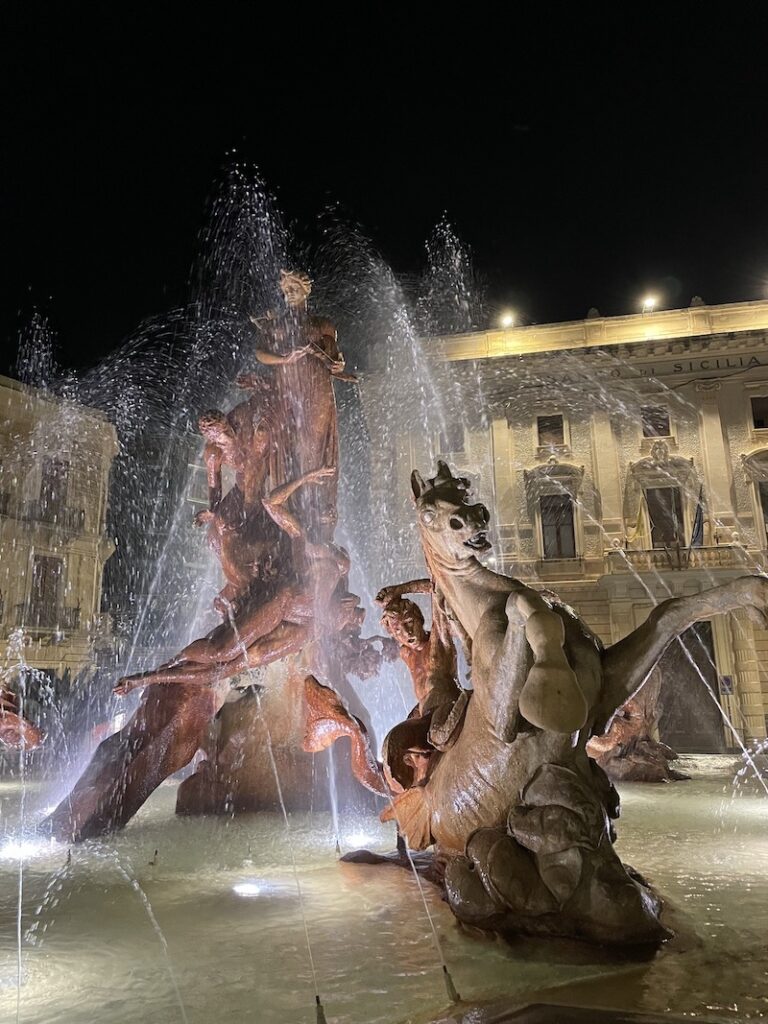


Artemis (also called Diana) was the goddess of the hunt and the patron saint of Ortygia in Greek times. The river god Alpheus was in love with Arethusa, but that love was not mutual.
According to legend, she fled to Ortygia and asked Artemis for help, who turned her into a spring of fresh water, making her inaccessible to Alpheus. This event is depicted here; Artemis is standing here with bow and dog and Arethusa at her feet is slowly becoming a spring of fresh water, Alpheus looks on displeased.
Some fine historic buildings overlook the square; the Palazzo Platamone (or the Palazzo della Banca d'Italia) from the 15e century and rebuilt in the 50s, Palazzo Gargallo from the 18e century and the 16ecentury Palazzo Lanza Buccheri.
3.Piazza del Duomo

Besides the cathedral and many terraces, you will find the Palazzo Borifa here and at the end of the square the church Santa Lucia alla Badia, destroyed by the earthquake of 1693 and then rebuilt.

You used to be able to admire a painting by Caravaggio in this church, but it has been transferred to the church of Santa Lucia al Sepolcro (in the new town). Caravaggio, spent some time in Syracuse after his time in Malta.
On the other side of the square are the Palazzo Vermezio (Town Hall) from the 17e century, built on the remains of a Greek temple, the Palazzo Beneventano del Bosco from the end of the 18e century and the Palazzo Vescovile.
4. Il Duomo

The cathedral, too Santa Maria del Piliero (Piliero means column), is built on the remains of a Greek temple, both inside and outside you can still see the Greek columns.


This temple was dedicated to the goddess Athena and dates back to the 6e century BC During the time of Arab rule, the temple was probably used as a mosque.
The Normans built a new facade and a bell tower. After the facade and bell tower collapsed in the devastating earthquake of 1693, the church was built in its present form, but without the bell tower.
5. Fonte Arethusa

This spring is named after Arethusa the nymph who was turned into a freshwater spring by Artemis to escape the love of the river god Alpheus.
However, the story goes that after his lover had become a spring, Alpheus turned himself into a river that flowed under the sea and quite by chance came above ground at the spring so that he could be with Arethusa after all….
The source is locally known as A funtana re papyri. In the spring there are large papyrus plants and these, together with the papyrus, are in the river Fiumedreddo (near Taormina, also in Sicily) are the only original papyrus plants in Europe.

You will find it on the other side of Ortygia Papyrus Museum, a small museum about the history of papyrus, papyrus objects and extensive explanations of how to make paper from this plant.
6. Castello Maniace

At the tip of Ortygia is the Castello Maniace, named after the Byzantine general Maniakes, built by order of Emperor Frederick II. It is built with 3 types of stone: limestone, lava and sandstone.
It suffered greatly from the earthquake and from an explosion of the powder magazine in 1704, as well as from the use of the castle as a barracks and prison. The castle can now be visited. Tickets costs 4 euros per person or 2 euros at a reduced rate.
7. Teatro Museo Siracusa dei Puppi

Here you can attend a performance by the famous Puppy Siciliani, wooden puppets that can be up to 150 cm tall and weigh 20 kg. In addition to a performance, you can also view the museum and the workshop.
The most important tips for the new city of Syracuse
With that we have had the most important sights for the old part of Syracuse, but the new city is also worth a visit. Here are the 6 highlights that you should not miss during your visit to the city.
1. Madonna delle Lacrime

The 'new' city is characterized by the church Madonna delle Lacrime (the weeping Madonna) a huge concrete structure with a tear-shaped spire that towers above everything.
2. Archaeological Park of the Neapolis
But it is the tourist attraction of the new city Archaeological Park of Neapolis.


A visit to this archaeological park is a must! Here you can admire both Greek and Roman antiquities, there are signs with QR codes everywhere that you can scan for a lot of information.
3. Latomie del Paradiso
These were originally quarries that were largely underground and covered with all kinds of caves and tunnels from the 5e century BC The stones that were carved here were used for the construction of the city. Now it is beautifully overgrown with many orange trees.
Here is also the cave called the 'Ear of Dionysios', the cave resembles an auricle, is 65 m long and 23 m high. The cave has surprising acoustic effects; even whispers resonate throughout the cave.

The story goes that the tyrant Dionysios made a slit at the top of the cave so that he could eavesdrop on his political opponents and prisoners unseen. The cave's name was probably given by Caravaggio, who was inspired by the shape of the cave's opening, which, according to the painter, resembled a donkey's ear.
4. Teatro Greco
Here were in the 5e century BC already staged plays by Aeschylus and Euripides. In the 2e century BC it was enlarged to the current theater.

Together with that of Athens, it was the largest theater of antiquity with a diameter of 138 m and about 15.000 seats. As with other Greek theaters, the spectator rows were carved into the rock. It also served as a meeting place for the popular assemblies.
In Roman times, the theater was adapted for gladiator fights. The theater was flooded to reenact naval battles. Then it fell into disrepair. Today, the theater is used again for performances in the summer months.
5. Amfiteatro Romano
After the Colosseum and the Arena of Verona, this is the largest Roman amphitheatre. It dates back to the Roman Imperial era. It is elliptical in shape. Gladiator and animal fights were held here.

The rectangular recess in the center was originally a well that was covered, an underground passageway ran from this well to the entrance on the south side of the theater. This corridor was necessary for machines used during the performances.
6. Beach & Swimming

In the summer months it can be very hot in Syracuse, nothing is as nice as a refreshing dip. In Ortygia there are two places to swim, at the Forte Vigliena on Via Nizza and on the other side, at the Lungomare.

Nearby are beautiful beaches such as Ognina, Arenella, Fontane Bianche and RNO di Vendicari.
Eating out in Syracuse
Are you staying for a nice bite to eat? There are many nice restaurants, osteria, pizzeria and so on in Syracuse. We have a few tips for you, in different price ranges.

In the new city:
- Olivia Natural Bistro: is a bar/pizzeria that also serves vegetarian and vegan dishes, Viale Teocrito 118.
- Ristorante Zen & Jonico, Riviera Dionisio Il Grande, 194, nice view over the sea.
In Ortygia:

- A Putìa, typical Sicilian cuisine, Via Roma 8.
- Ristorante Don Camillo: Via delle Maestranza 96, this restaurant is recommended by Michelin.
- Trattoria Spizzuliamu, Via Consiglio Reginale, 33, good food and friendly service.

Overnight in Syracuse

There are many hotels in Syracuse, both in the new town and in Ortygia. There is also a lot of renting out through Airbnb and similar sites. If you come by car, staying overnight in the new city is easier, because parking is usually free. Spending the night on the island of Ortygia is of course more atmospheric.
👉 Check out the best deals on accommodations in Syracuse on booking.com.
Typical dishes from Syracuse
Don't miss these typical Syracusan specialties!
- Granita con Brioche: a refreshing breakfast for when it is very hot. Granita is semi-frozen ice cream in different flavors and served with a brioche, a kind of Italian croissant. It is also eaten with cream.
- scacce (also Crush called): a kind of small focaccia that is filled with, for example, eggplant, tomato, zucchini.
- Pasta fritta (fried pasta): very thin spaghetti with anchovies and olive oil and some toasted breadcrumbs to make it crispy.
- Purpette di tonno da Za'Cicca: tuna balls with pecorino cheese, breadcrumbs, garlic, parsley, eggs and cloves.
- Cuccia di Santa Lucia: the patron saint of Syracuse is Santa Lucia and this dessert is dedicated to her, it consists of cooked wheat, sweet ricotta, candied fruit, chocolate and almond pieces.








Comments